








The Schumann · Sleep, from a skeptic
I thought it was nonsense. Then I learned what Schumann Resonance actually is.
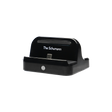
I rolled my eyes the first time someone mentioned Schumann Resonance to me. A coworker had one of those small black boxes on her nightstand, and when I asked about it, she said it was the reason she had finally started sleeping through the night. Something about Earth's heartbeat and 7.83 Hz. I remember thinking, here we go.
I'd seen the bracelets. I'd seen the Instagram pages talking about mass awakenings and ascension symptoms and some kind of planetary consciousness shift. None of that held up for me, and it still doesn't. If someone tells you a headache means you're vibrating to a higher dimension, that's not a theory. That's a way to avoid seeing a doctor.
But sleep is a different claim than ascension. Sleep is something you can actually measure, night after night, without believing in anything. So I went looking for the part that wasn't nonsense.
That's not a theory. That's a way to avoid seeing a doctor.
What actually changed my mind
Here's the part I didn't expect. The first night, I felt nothing. No tingling, no obvious shift, nothing dramatic enough to write home about. I almost returned it.
What changed my mind wasn't a feeling. It was my own sleep tracker. Three nights in, my deep sleep numbers were up, consistently, not a one-off good night. I hadn't changed anything else. Same bedtime, same stress, same everything.
A feeling can be argued with. A trend line across your own data is harder to dismiss.
Why it works
In 1952, physicist Winfried Otto Schumann worked out that the gap between the Earth's surface and the ionosphere acts like a cavity, resonating at roughly 7.83 Hz. Two researchers confirmed it experimentally eight years later. Decades after that, a NASA satellite picked up the same signal somewhere nobody expected, forcing a real revision in how scientists modeled low frequency wave behavior in the Earth-ionosphere system. This is an actively studied piece of geophysics, not an internet rumor.
Then there's the Wever and Aschoff bunker experiments, run out of the Max Planck Institute from the 1960s through the 1980s. Volunteers shielded from Earth's natural electromagnetic field for weeks showed disrupted circadian rhythms, the cycle that governs when your body decides it's time to sleep. Some accounts describe symptoms easing once a matching low frequency field was reintroduced. It's an old result and still debated. We're not calling it settled.
What is undisputed is the coincidence. That 7.83 Hz number sits right in the range of human alpha brainwaves, the ones that show up as the brain downshifts toward rest.
Standard EEG brainwave band ranges, widely published in neuroscience literature. The 7.83 Hz line sits just under the alpha band, the coincidence referenced above.
W.O. Schumann (1952), confirmed 1960
Predicted by math that the Earth-ionosphere cavity resonates near 7.83 Hz, then confirmed experimentally.
NASA satellite data
Detected a comparable signal in an unexpected location, forcing a revision of existing propagation models.
Wever and Aschoff, Max Planck Institute
Volunteers shielded from Earth's EM field showed circadian disruption. An old, still debated result.
The few questions every skeptic asks
Is this just placebo?
Maybe partly, for some people, some of the time. Placebo doesn't explain a sleep tracker's deep sleep
percentage climbing for three straight nights with nothing else in your routine changed. You don't have to
take our word for the mechanism either. You can watch the field itself.
Open any EM field reader app with the device off. Nothing registers beyond ordinary background noise. Turn it on, and the reading jumps immediately, on screen, in front of you. That's not a sound playing through a speaker. It's an actual electromagnetic field, generated by the device, measured by a tool that has no reason to lie to you.
Illustrative example only. Exact readings depend on the field reader app and device used.
That's the distinction most competitors blur. A frequency app or a binaural beat track plays a tone through your speaker. Sound is not a field. You can mute a speaker. You can't mute a real electromagnetic reading on a meter.
Is it safe?
It ships with a 30 night window. Use it, check your own data, send it back if nothing changed.
Your smart ring isn't wrong. It's just not built to fix anything.
If you wear a ring or a watch that tracks your sleep, you already know the feeling. The app tells you your recovery is low, your deep sleep is thin, your readiness score is a 61. It's accurate. It's also just a readout.
A tracker measures the problem. It was never built to act on it.
The Schumann works on the room, not your wrist. One measures what's happening in your body overnight. The other changes the environment your body is reading while it sleeps. They're not competing for the same job, so there's no reason to choose. Keep wearing the ring. Keep the watch on. They're the witness, and this is the thing you're testing.


That's what this looks like in practice. Mike was waking up ten or more times a night, and he knew his watch would show him whether anything he tried made a difference. His own tracker is what told him it did.
What else is out there, and where it stops
A tracker is the diagnostician. This is the intervention. Here's where the rest of the frequency and wellness category stops short.
| Does well | Cannot reach | |
|---|---|---|
| Frequency apps | Cheap, convenient, easy to try | Plays a tone through a speaker. Sound, not a field |
| Grounding mats | Real conductive contact with the body | Limited to direct skin contact. Doesn't condition the room |
| EMF stickers and shields | No batteries, passive | Blocks or absorbs. Generates nothing |
| Sound based sleep devices | Pleasant, decent build quality | Still audio. Still not a field |
| The Schumann, 7.83 Hz frequency generator | Generates a real, measurable Schumann resonance field in the room, the same signal confirmed by NASA and studied since 1952 | |
A tracker is the diagnostician. Ours is the intervention.
People who were skeptical too
These aren't ours. They're screenshots, pulled straight from reviews and comments, skeptics first, most of them.


Don't believe us. Check your own data.
We're not asking you to trust a feeling, or trust us. Put a field reader app on it. Put your own sleep tracker on it. Run it for 30 nights and let your own numbers decide.

Start with the V3 Max
The full 0.01 to 9,999.99 Hz range, five presets. The one most people land on when they want the complete setup from the start.
Rather start simpler?
The V1 runs one fixed frequency, 7.83 Hz, one button. The lowest cost way to see if the baseline signal moves your own numbers before going further.
Use WAVE10 for 10% off.
Thirty nights. If your own data doesn't move, send it back.